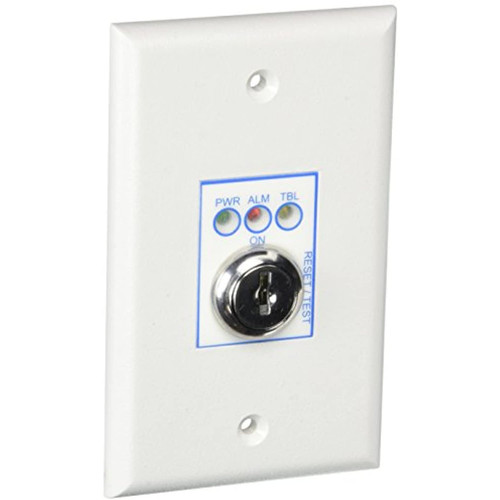



The SD-TRK is a keyed remote test and reset station for SuperDuct duct smoke detectors. It puts test and reset control at an accessible wall location instead of at the detector, which matters when the detector is sitting on a rooftop unit or above a hard ceiling. The red alarm LED on the plate shows the detector's status without opening anything.
Built for the commercial fire installer
Duct detectors are almost always mounted somewhere inconvenient. Annual testing and post-alarm resets mean a ladder, a lift, or roof access every time, unless the station is brought down to a wall. The SD-TRK does that with a keyswitch, so only authorized staff can test or reset the detector. It fits a standard North American 1-gang box or a 4-inch square box with a 1-gang cover, and wiring is ordinary 12 to 22 AWG.
Switch contacts are rated to 125 VDC at 4 amps, well beyond what a duct detector circuit asks of them. Listed by UL, ULC, FDNY, CB, and CC.
Key features
- Keyed operation: test and reset restricted to staff with the key, unlike a magnet-operated station
- Remote alarm LED: red alarm indicator on the plate shows detector status from the wall
- Standard box mounting: 1-gang box, or a 4-inch square box 1-1/2 inches deep with a 1-gang cover
- High switch rating: 125 VDC at 4 amps maximum
- Wide temperature range: rated 32 to 131 F for mechanical rooms and unconditioned spaces
System requirements
For use with SuperDuct conventional two-wire and Signature duct smoke detectors. Wire with 12 to 22 AWG, keeping resistance under 10 ohms per wire. An end-of-line resistor is required on the last controller only, and its value is set by the fire alarm control panel. Do not loop wires under the terminals; break the run so connections stay supervised. For a magnet-operated station instead of keyed, order the SD-TRM.
What is the difference between the SD-TRK and the SD-TRM?
Which duct detectors does the SD-TRK work with?
What box does this mount to?
Does the station need its own power?
Where does the end-of-line resistor go?
Spec Sheet