




- Frequency Jeweller

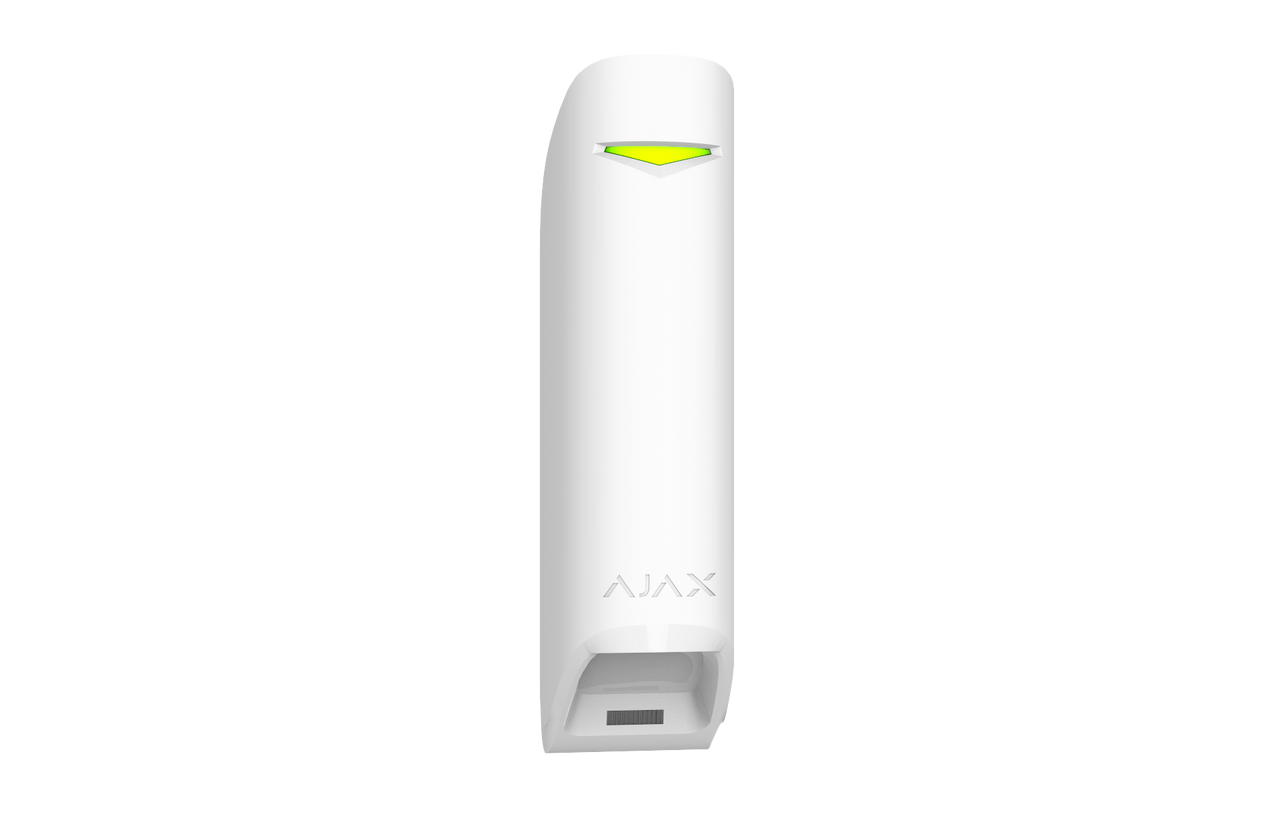
MotionProtect Curtain Jeweller Narrow-Beam Curtain Motion Detector, White
SKU AJ-42825
- Fast shipping from four branches
- 30-day returns on unopened products
A curtain detector throws a narrow vertical beam, 6 degrees wide by 90 degrees tall, rather than a wide room-covering fan. That lets you protect the plane of a window or a doorway while leaving the space behind it completely uncovered.
Built for the installer
The application that sells it is perimeter-armed occupancy: the customer wants the windows and patio doors protected while people move freely inside. A standard PIR cannot do that. A curtain detector mounted at the opening can.
It uses two PIR sensors with a detection range of about 19.7 to 49 feet depending on configuration. Mount it upside down to stop it reacting to domestic animals at floor level. Battery life is up to 3 years, shorter than the standard detectors, so factor that into a service schedule.
Key features
- 6-degree horizontal beam protects a window plane without covering the room behind it
- Enables perimeter-armed occupancy, the customer stays in while the openings stay protected
- Two PIR sensors with detection from roughly 19.7 to 49 ft
- Mount inverted for pet tolerance at floor level
- Three sensitivity levels adjustable in the app
System requirements
Requires an Ajax hub or range extender. Install upside down to avoid reacting to domestic animals. Battery life is up to 3 years, shorter than standard detectors.
Specifications
| SKU | AJ-42825 |
|---|---|
| Brand | AJAX |
| Radio communication range | Up to 5,550 ft in open space, between the device and a hub or range extender |
| Sensitive elements | 2 x PIR sensor |
| Motion detection distance | Up to 19.7 to 49 ft depending on configuration |
| Detection angle | Horizontal 6 degrees, vertical 90 degrees |
| Detection speed | From 1.0 to 6.6 ft/s |
| Sensitivity | 3 levels, adjustable in the Ajax app |
| Pet tolerance | Install the detector upside down to prevent reaction to domestic animals |
| False alarm filtering | Temperature compensation, effective from 14F to 104F |
| Sabotage protection | Tamper alarm on enclosure opening or removal from the mounting panel |
| Power input | 1 x CR123A, pre-installed |
| Battery life | Up to 3 years |
| Dimensions | 5.28 x 1.73 x 1.34 in |
| Colour | White |
| Region | 9NA, North America model |
| Radio protocol | Jeweller, two-way encrypted wireless |
| Frequency band (North America) | 905.0-926.5 MHz, certified to UL/ULC standards |
| Radio modulation | GFSK with frequency hopping |
| Encryption | Block encryption with a dynamic key |
| Communication loss detection | After 36 seconds |
| Anti-spoofing | Device authentication |
| Warranty | 24 months |
| Frequency | Jeweller |


