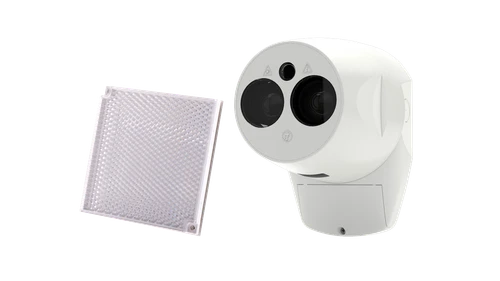



Reflective Beam Smoke Detector, Conventional 4-Wire, 160-330 ft Range, UL/ULC Listed
SKU KD-EC-100R
- Fast shipping from four branches
- 30-day returns on unopened products
The Kidde EC-100R covers large open areas - warehouses, atriums, gymnasiums, industrial plants - where conventional spot detectors can't reach. A single unit houses both transmitter and receiver, projecting an infrared beam to a reflector panel mounted up to 330 feet away. When smoke enters the beam path, the detector measures the obscuration and triggers the alarm. No complicated multi-head layouts, no ceiling-mounted spot detectors every 30 feet.
Built for the commercial installer
The EC-100R operates on 10.2-30 VDC and wires into any UL-listed 4-wire conventional fire alarm control panel. Standby current draws less than 4 mA, so it won't tax existing NAC circuits. Automatic gain control compensates for gradual signal loss from dust or component aging - the detector checks itself every 15 minutes and adjusts, keeping nuisance trouble calls off your schedule. UL, ULC, and CE listed.
Key features
- 160 to 330 ft detection range with a group of four reflectors - covers up to 19,800 sq ft of open area under flat ceilings
- Selectable alarm thresholds (25%, 35%, 50% obscuration) to match the environment's smoke density profile
- Automatic drift compensation adjusts for lens contamination and component aging without manual recalibration
- Latching or non-latching operation configurable at the detector
- Optional ground-level test station (EC-LLT) for safe, key-operated testing without ladder access
- Separate fire and trouble relays provide distinct zone reporting back to the FACP
System requirements
Connects to any UL-listed 4-wire conventional fire alarm control panel via an 8-pin field connector. Requires a clear line of sight to the four-reflector panel mounted directly opposite. Install 19-24 inches below the ceiling per NFPA 72 spacing guidelines. All objects must stay at least 19 inches from the beam center path. The optional EC-LLT ground-level test station connects via a 2-wire data link cable and must be located within 330 ft of the detector junction box.
Specifications
| SKU | KD-EC-100R |
|---|---|
| Brand | Kidde Commercial |
| Form factor | Reflective beam smoke detector, integrated transmitter/receiver |
| Detection type | Projected infrared beam, reflective |
| Detection range | 160 ft to 330 ft (48.8 m to 100 m) |
| Beam coverage width | 30 ft (9.14 m) either side of beam |
| Max area coverage | 19,800 sq ft (1,844 sq m) under flat ceilings |
| Power input | 10.2 VDC to 30 VDC (continuous) |
| Current draw | Standby: |
| Alarm thresholds | 25% (2.50 dB), 35% (3.74 dB), 50% (6.02 dB) obscuration |
| Optical wavelength | 880 nm infrared |
| Relay contacts | Fire: NO, 2A 30 VDC resistive; Trouble: NC, 2A 30 VDC resistive |
| Signal delay | 10 seconds (alarm and trouble) |
| Reset time | >5 seconds (power down) |
| Wiring | 4-wire conventional, 8-pin connector, #12-#18 AWG |
| Reflectors required | Group of four reflectors (included) |
| Dimensions | 8.25 x 5.1 x 4.7 in (21 x 13 x 12 cm) (H x W x D) |
| Operating temp | 32°F to 100°F (0°C to 37°C) |
| Operating humidity | 93% RH max, non-condensing |
| Mounting | Wall mount, 19-24 in below ceiling, vibration-free surface |
| Compliance | UL 268, ULC, CE |
| Ship weight | 2.0 lb (0.90 kg) |
Documents and resources
FAQs
What range does the EC-100R cover?
What kind of fire alarm panel does this connect to?
Does the detector compensate for dirty lenses over time?
How do I test it without climbing up to the detector?
Can I use this outdoors or in extreme temperatures?
What's the difference between the EC-50R and EC-100R?
More in Kidde Commercial
All Kidde Commercial-
Kidde Commercial
Kidde | Fireray One Auto-Aligning Reflective Beam Smoke Detector, 50M (164 ft) Range, UL/ULC | KC1-50
KD-KC1-50 -
Kidde Commercial
Kidde | Replacement Prismatic Reflector for EC-50R/EC-100R Reflective Beam Smoke Detectors | 23901-01
KD-23901-01 -
Kidde Commercial
Kidde | Ceiling Mount for EC-50R/EC-100R Reflective Beam Smoke Detector, Beige | 1142-000
KD-1142-000 -
Kidde Commercial
Kidde | Fireray One Auto-Aligning Reflective Beam Smoke Detector, 50M Range, IP55, UL/ULC | 6010-300
KD-6010-300