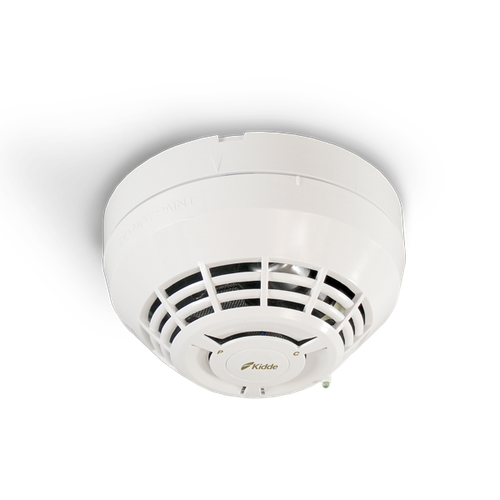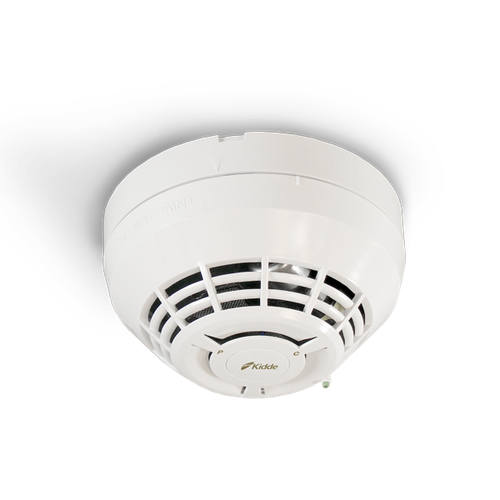



Intelligent Carbon Monoxide (CO) Detector, Rotary-Addressed with Electrochemical Sensor, UL 2075
SKU KD-KIR-COD
- Fast shipping from four branches
- 30-day returns on unopened products
The KIR-COD drops intelligent carbon monoxide detection onto any Kidde KIR Series SLC loop without new wiring or infrastructure changes. An electrochemical CO sensor handles detection while the on-board microprocessor filters nuisance alarm patterns, keeping false calls off the panel and callbacks out of your schedule.
Built for the commercial installer
Rotary addressing makes commissioning fast - set the address on the detector before mounting and move on. The KIR-COD mounts to standard North American 1-gang, 3-1/2" and 4" octagon, and 4" square electrical boxes (1-1/2" deep), plus European BESA boxes. Compatible with the full range of KIR Series bases - standard (KI-SB), relay (KI-RB), isolator (KI-IB), and audible sounder (KI-ABDT, KI-ABLT) - so one detector platform covers standalone CO detection, fault isolation, and localized audible signaling. UL 2075 listed and evaluated to UL 2034 CO alarm sensitivity limits.
Key features
- Electrochemical CO sensor with 10-year life - signals trouble to the panel at end of life so you schedule replacement, not guess
- Rotary addressing for up to 250 devices per loop - no DIP switches, no programming tool needed at the device
- Automatic day/night sensitivity adjustment reduces nuisance alarms in occupied spaces without manual scheduling
- Non-volatile memory stores self-diagnostic history and device mapping data through power loss
- Bicolor LED (green/red) provides at-a-glance status from the ground during walkthroughs
- Multiple base options - standard, relay, fault isolator, and audible sounder bases all fit the same mounting footprint
System requirements
Requires a Kidde KIR Series Loop Controller. Operates on SLC loop power at 15.20 to 19.95 VDC with minimal current draw (51 µA standby, 68 µA alarm). For CO-specific audible signaling at the detector location, pair with a KI-ABDT or KI-ABLT sounder base and an FX-T3T4 Temporal Pattern Generator to produce the required TC4 tone pattern.
Specifications
| SKU | KD-KIR-COD |
|---|---|
| Brand | Kidde Commercial |
| Form factor | Ceiling-mount intelligent CO detector, round profile |
| Communication | SLC (Signaling Line Circuit) to KIR Series Loop Controller |
| Operating voltage | 15.20 to 19.95 VDC (SLC loop power) |
| Normal operating current | 51 µA |
| Alarm current | 68 µA |
| Sensor type | Electrochemical carbon monoxide |
| Sensor life | 10 years from date of manufacture |
| Addressing | Rotary, up to 250 addresses per loop |
| Operating temp | 32 to 120°F (0 to 49°C) |
| Operating humidity | 0 to 90% RH, noncondensing |
| Storage temp | -4 to 140°F (-20 to 60°C) |
| Construction | High Impact Engineering Polymer, White |
| Mounting | 1-gang, 3-1/2" or 4" octagon, 4" square boxes (1-1/2" deep), European BESA boxes |
| Wire size | #12 to #18 AWG |
| Compatible detector testers | Testifire 1000, Testifire 2000 |
| Vibration rating | 10 to 35 Hz, amplitude 0.01 in. |
| Compliance | UL 2075, evaluated to UL 2034 CO alarm sensitivity limits |
| CO alarm levels (UL 2034) | 70 ppm: 60-240 min, 150 ppm: 10-50 min, 400 ppm: 4-15 min |
Documents and resources
FAQs
What panel is the KIR-COD compatible with?
What mounting bases work with this detector?
How long does the CO sensor last?
Does this detector require a separate power supply?
How do I test this detector in the field?
Does the KIR-COD provide audible CO alarm at the detector?
More in Kidde Commercial
All Kidde Commercial-
Kidde Commercial
Kidde | Intelligent Multisensor Smoke and CO Detector with Rotary Addressing | KIR-PCD
KD-KIR-PCD -
Kidde Commercial
Kidde | Intelligent Multisensor Smoke, Heat & CO Detector, Rotary-Addressed | KIR-PHCD
KD-KIR-PHCD -
Kidde Commercial
Kidde | Intelligent Optica Rotary-Addressable Photoelectric Smoke and CO Detector | KIR-OSCD
KD-KIR-OSCD -
Kidde Commercial
Kidde | Intelligent Optica Rotary-Addressed Multisensor Smoke, Heat and CO Detector | KIR-OSHCD
KD-KIR-OSHCD