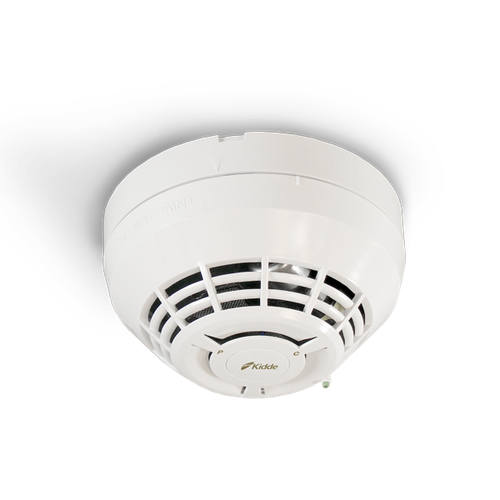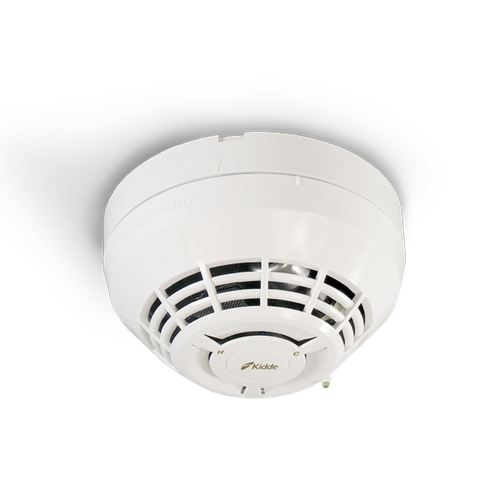



Intelligent Multisensor Smoke and CO Detector with Rotary Addressing
SKU KD-KIR-PCD
- Fast shipping from four branches
- 30-day returns on unopened products
The Kidde KIR-PCD combines photoelectric smoke and electrochemical CO detection in a single intelligent device, cutting install time and ceiling real estate on commercial fire alarm jobs. Rotary addressing lets you set addresses at the detector - no laptop required on the lift.
Built for the commercial fire alarm installer
Designed for Kidde FX Series intelligent fire alarm control panels, the KIR-PCD supports up to 250 addresses per SLC loop. Automatic environmental compensation adjusts for dust, humidity, and temperature drift, reducing nuisance alarms and callbacks. The 10-year electrochemical CO sensor means fewer service visits over the life of the system. UL 268 and UL 2075 listed, with ULC listing to CAN/ULC-S529 and CAN/CSA 6.19.
Key features
- Dual-sensor detection: photoelectric smoke and electrochemical CO in one device - fewer ceiling penetrations, lower material cost
- Rotary addressing: set device addresses mechanically, no programming tool needed at the detector
- Five sensitivity settings and twenty pre-alarm thresholds configurable from the FACP for application-specific tuning
- Automatic environmental compensation reduces nuisance alarms from dust, humidity, and temperature changes
- Self-diagnostics with bicolor LED for quick visual status during walkthroughs
- 10-year CO sensor life minimizes long-term service cost
System requirements
Requires a Kidde FX Series intelligent fire alarm control panel and a compatible KI Series mounting base (KI-SB standard, KI-IB isolator, KI-RB relay, or audible sounder bases for CO and fire tone patterns). Mounts to standard 4" square, 4" octagon, or 1-gang electrical boxes with 1.5" minimum depth.
Specifications
| SKU | KD-KIR-PCD |
|---|---|
| Brand | Kidde Commercial |
| Form factor | Ceiling-mount intelligent detector, High Impact Engineering Polymer, White |
| Detection type | Photoelectric smoke + electrochemical CO |
| Communication | SLC loop (Kidde FX Series intelligent fire alarm panels) |
| Addressing | Rotary, up to 250 addresses per loop |
| Operating voltage | 15.20 to 19.95 VDC |
| Operating current | 32 μA (normal and alarm) |
| Smoke sensitivity range | 0.53 to 3.94 %/ft (1.7 to 12.35 %/m) obscuration |
| CO alarm level | 70 ppm: 60-240 min, 150 ppm: 10-50 min, 400 ppm: 4-15 min (per UL 2034) |
| CO sensor life | 10 years |
| Sensitivity settings | Five settings, twenty pre-alarm thresholds |
| Operating temp | 32 to 120°F (0 to 49°C) |
| Operating humidity | 0 to 90% RH, noncondensing |
| Storage temp | -4 to 140°F (-20 to 60°C) |
| Mounting | 1-gang, 3.5" or 4" octagon, 4" square electrical boxes (1.5" min depth) |
| Wire size | #18 AWG to #12 AWG |
| Compatible bases | KI-SB, KI-SB4, KI-IB, KI-IB4, KI-RB, KI-RB4, KI-ABLT, KI-ABDT |
| Compatible detector testers | Testifire 1000, Testifire 2000 |
| Construction | High Impact Engineering Polymer, White |
| Compliance | UL 268, UL 2075, ULC to CAN/ULC-S529 and CAN/CSA 6.19 |
| Weight | 0.4 lbs (0.16 kg) |
Documents and resources
FAQs
What panels is the KIR-PCD compatible with?
What mounting bases work with this detector?
How long does the CO sensor last?
Does it require a programming tool for addressing?
What electrical boxes does it mount to?
What are the UL CO alarm thresholds?
More in Kidde Commercial
All Kidde Commercial-
Kidde Commercial
Kidde | Intelligent Multisensor Smoke, Heat & CO Detector, Rotary-Addressed | KIR-PHCD
KD-KIR-PHCD -
Kidde Commercial
Kidde | Intelligent Optica Rotary-Addressed Multisensor Smoke, Heat and CO Detector | KIR-OSHCD
KD-KIR-OSHCD -
Kidde Commercial
Kidde | Intelligent Optica Rotary-Addressed Multisensor Smoke and Heat Detector | KIR-OSHD
KD-KIR-OSHD -
Kidde Commercial
Kidde | Intelligent Multisensor Heat and CO Detector, Rotary-Addressed, SLC Loop Powered | KIR-HCD
KD-KIR-HCD -
Kidde Commercial
Kidde | Intelligent Optica Rotary-Addressable Photoelectric Smoke and CO Detector | KIR-OSCD
KD-KIR-OSCD