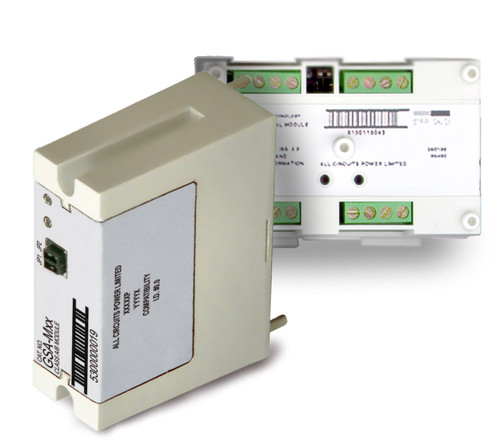



Intelligent Analog Addressable Class A Single Input Module for FX Series Fire Alarm Panels
SKU KD-GSA-CT1
- Fast shipping from four branches
- 30-day returns on unopened products
The Kidde GSA-CT1 connects normally open dry contact initiating device circuits (IDCs) to the SLC loop of Kidde FX Series fire alarm control panels. Class A wiring provides redundant circuit paths so a single wire break won't take the zone offline - critical in high-rise, healthcare, and institutional occupancies where code requires Class A circuit operation.
Built for the commercial fire alarm installer
Rotary-switch addressing keeps commissioning simple - set the TENS and ONES dials, mount the module in a standard 4-inch electrical box, and register it from the panel. Four selectable personality codes (alarm latching, alarm delayed latching, non-latching monitor, and latching supervisory) let you match the module to the specific device type right at the module, without returning to panel programming. Ground fault detection pinpoints the exact module with a wiring problem, cutting troubleshooting time on large SLC loops.
Key features
- Class A (Style D) circuit operation for code-compliant redundant IDC monitoring
- Four selectable personality codes configurable at the module - alarm latching, alarm delayed latching, non-latching monitor, and latching supervisory
- Rotary-switch addressing from 01 to 127 - no programming tool needed
- Ground fault detection pinpoints the specific module with a wiring fault
- Bicolor LED status - flashing green (normal), flashing red (active) - visible during walkthroughs
- Mounts in standard 4-inch electrical boxes - 2-gang or single-gang, no special hardware
System requirements
Connects to the SLC (Signaling Line Circuit) of any Kidde FX Series intelligent fire alarm control panel. Supports 64 device addresses on a 64-point panel or up to 127 on a 1000-point panel. Wire with 12-18 AWG (16 and 18 AWG preferred).
Specifications
| SKU | KD-GSA-CT1 |
|---|---|
| Brand | Kidde Commercial |
| Form factor | Analog addressable Class A single input module with wall plate |
| Communication | SLC (Signaling Line Circuit) to Kidde FX Series intelligent fire alarm panels |
| Communication line voltage | Maximum 20 V peak-to-peak |
| Current draw | Standby 400 µA, Activated 500 µA |
| Personality codes | Alarm latching, alarm delayed latching, non-latching monitor, latching supervisory |
| Addressing | Rotary switches (TENS 0-12, ONES 0-9) |
| Device address range | 01-64 (64-point panel), 01-127 (1000-point panel) |
| IDC circuit type | Normally open dry contact, Class A (Style D) |
| Max circuit resistance | 50 Ω (25 Ω per wire) |
| Max circuit capacitance | 0.1 µF |
| Ground fault impedance | 10 kΩ |
| Wire size | 12, 14, 16, or 18 AWG (16 and 18 AWG preferred) |
| Compatible electrical boxes | 4" square x 2-1/2" deep 2-gang box, standard 4" square box 1-1/2" deep |
| LED indicators | Bicolor - flashing green (normal), flashing red (active) |
| Operating temp | 32 to 120°F (0 to 49°C) |
| Operating humidity | 0 to 93% RH, noncondensing at 90°F (32°C) |
| Storage temp | -4 to 140°F (-20 to 60°C) |
| Compliance | UL, ULC, CSFM listed |
Documents and resources
FAQs
What devices can this module monitor?
What Kidde panels is this compatible with?
What is the difference between this and the FX-IDC1B?
How is the device address set?
What electrical box does this mount in?
What wire gauge is required?
More in Kidde Commercial
All Kidde Commercial-
Kidde Commercial
Kidde | Analog Addressable Class A Single Input Module for FX Series Fire Alarm Panels | FX-IDC1A
KD-FX-IDC1A -
Kidde Commercial
Kidde | Analog Addressable Dual Input Riser Module for FX Series Intelligent Fire Alarm Systems | GSA-CC2
KD-GSA-CC2 -
Kidde Commercial
Kidde | Analog Addressable Dual Input Module for FX Series Fire Alarm Panels | FX-IDC2B
KD-FX-IDC2B -
Kidde Commercial
Kidde | Analog Addressable NAC Output Module for FX-Series Fire Alarm Panels | FX-NAC
KD-FX-NAC