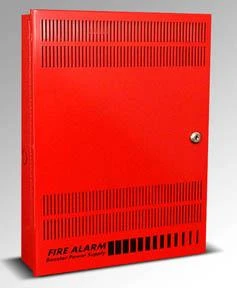



10 Amp Booster Power Supply, 4 Class B NAC Circuits with Battery Charger, UL 864 10th Edition
SKU KD-EBPS10A
- Fast shipping from four branches
- 30-day returns on unopened products
The EBPS10A Booster Power Supply adds 10 amps of supervised 24 Vdc power anywhere the job needs it, without pulling a new run back to the panel. Land it on an existing notification appliance circuit, configure up to four Class B (or two Class A) outputs at 3 amps each, and let the on-board charger carry the standby batteries. UL 864 10th Edition listed for fire alarm, Mass Notification/Emergency Communication (MNEC), and life safety work.
Built for the commercial fire installer
Cascading is the reason this unit saves time on a retrofit. Existing NAC end-of-line resistors stay exactly where they are, so several boosters can hang off one circuit with no special configuration and no re-engineering of the riser. The dual-input activation circuits accept 6 to 45 Vdc filtered-regulated or 11 to 33 Vdc full-wave rectified, which means it drops onto effectively any FACP already in the building. The keyed steel cabinet holds two 10 Ah batteries internally, or pairs with a BC-1 or BC-2 battery cabinet for up to 65 Ah of standby.
Seven on-board diagnostic LEDs (one per NAC, plus battery, ground fault, and AC power) mean a trouble call gets diagnosed at the enclosure instead of by process of elimination. Listed under UL, ULC, CSFM, NYC Fire Dept., and FM.
Key features
- Four Class B NAC outputs, convertible to two Class A: 3A per circuit with 10A total capacity at 24 Vdc
- Cascades on an existing NAC: no end-of-line resistor at the booster terminals, so multiple units drive off one circuit
- Outputs reconfigure as auxiliary power: any of the four can become 24 Vdc AUX, with optional 30-second drop after AC loss for door holders
- Genesis and Enhanced Integrity synchronization: notification appliances stay in step across the system
- Selectable signal rates: continuous, 3-3-3 temporal, or follow the host panel's coded NAC output
- Self-restoring overcurrent protection on every output, so a cleared fault does not mean a fuse change
- Room for three Signature two-gang modules mounted beside the circuit board for addressable integration
- Optional seismic hardening: the BPSEQ kit carries OSHPD pre-approval at component Importance Factor 1.5
System requirements
Drives from any fire alarm control panel NAC output or from Kidde Commercial Signature Series control modules such as the CC1(S), CT1, or CT2. Rated for indoor dry locations only. The enclosure is punched for 3/4-inch conduit and terminals accept 18 to 12 AWG. Batteries and the external battery cabinet are ordered separately.
Specifications
| SKU | KD-EBPS10A |
|---|---|
| Brand | Kidde Commercial |
| Weight | 14.9 lbs |
| Length | 14.5 in |
| Width | 18.3 in |
| Height | 5.2 in |
| Form factor | Keyed lockable steel wall-mount cabinet with removable door, 17.0 x 13.0 x 3.5 in (43.2 x 33.0 x 8.9 cm) |
| NAC output circuits | 4 Class B, field-convertible to 2 Class A |
| NAC output rating | 3.0A max per circuit, 10A max total across all NACs |
| NAC output voltage | 18.2 to 27.0 VDC |
| Power input | 120 VAC or 220-240 VAC, 50/60 Hz, 580 watts |
| Input activation voltage | 6 to 45 VDC filtered-regulated, or 11 to 33 VDC full-wave rectified |
| Input current from existing NAC | 3 mA @ 12 VDC, 6 mA @ 24 VDC |
| Auxiliary output | Four configurable outputs replacing NACs 1-4 (19.1 to 27.0 VDC), plus a dedicated 200 mA output (19.5 to 27.0 VDC) |
| Internal supervisory current | 70 mA, plus 35 mA for each circuit set to AUX |
| Internal alarm current | 270 mA |
| Battery capacity | Up to 10 Ah internal (two 12V10A); up to 65 Ah with external battery cabinet for fire applications |
| Output signal rates | Continuous, 3-3-3 temporal, or follow the installed panel's NAC |
| Notification appliance sync | Genesis and Enhanced Integrity synchronization |
| Trouble relay | 2A @ 30 VDC |
| Ground fault detection | Enable or disable via jumper |
| NAC wiring styles | Class A or Class B |
| Signature module mounting | Accommodates three two-gang modules |
| Terminal wire gauge | 18 to 12 AWG |
| Conduit | 3/4-inch knockouts |
| Mounting | Indoor dry locations only |
| Operating temp | 32 to 120 F (0 to 49 C) |
| Operating humidity | 0 to 93% non-condensing @ 32 C |
| Compliance | UL 864 10th Edition, UL 636, UL 609, UL 365, UL 1076, UL 1610, ULC-S527, ULC-S303, C22.2 No. 205 |
| Agency listings | UL, ULC, CSFM, NYC Fire Dept., FM |
| Shipping weight | 13 lb (5.9 kg) |
Documents and resources
FAQs
Can I cascade multiple boosters on one NAC circuit?
Does the EBPS10A support Class A NAC wiring?
What fire alarm panels does this work with?
How much battery backup can it support?
Can the NAC outputs be used as auxiliary 24V power instead?
What is the difference between the EBPS6A and the EBPS10A?
Can this be installed outdoors?
Is a seismic-rated version available?
More in Kidde Commercial
All Kidde Commercial-
Kidde Commercial
Kidde | 10 Amp Remote NAC Booster Power Supply with Battery Backup, UL 864 10th Edition | MIRBPS10A
KD-MIRBPS10A -
Kidde Commercial
Kidde | 6.5A Remote NAC Booster Power Supply, 4 Class B/2 Class A Circuits, UL 864 10th Edition | EBPS6A
KD-EBPS6A -
Kidde Commercial
Kidde | 6.5 Amp Remote Booster Power Supply with Four Supervised NAC Circuits, UL 864 10th Edition | MIRBPS6A
KD-MIRBPS6A