
You save

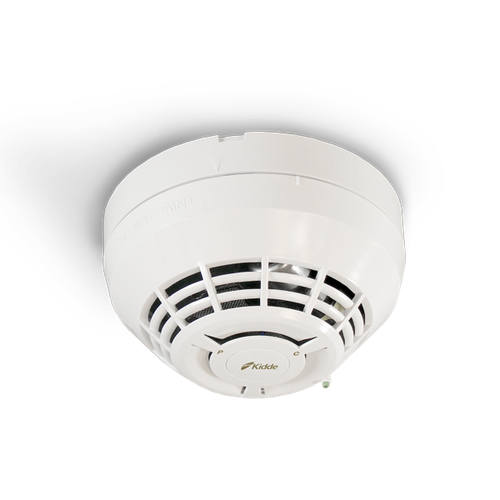
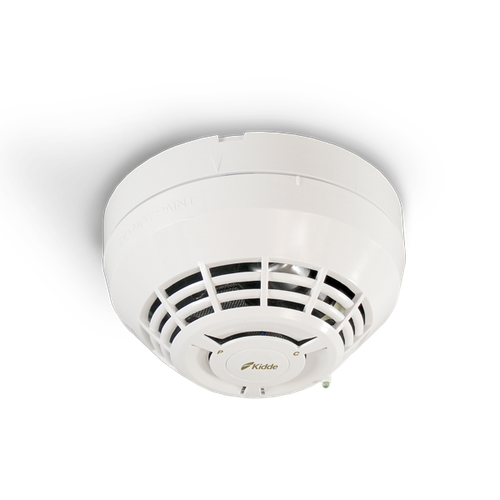
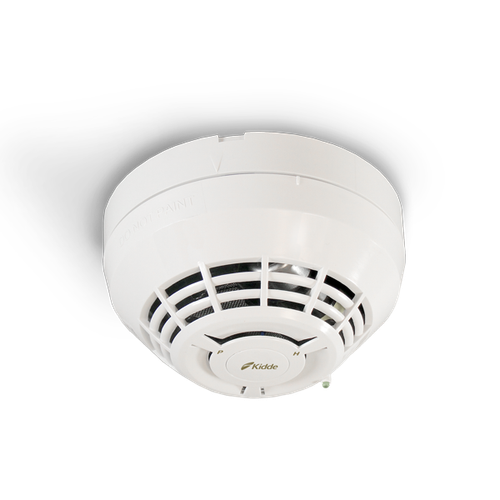
Kidde | Intelligent Multisensor Photoelectric Smoke and Rate-of-Rise Heat Detector, Rotary Addressed, UL/ULC Listed | KIR-PHD

No reviews yet Write a Review
SKU:
KD-KIR-PHD

The Kidde KIR-PHD pairs a photoelectric smoke sensor with a rate-of-rise heat sensor in a single head, covering both smoldering and fast-flaming fire signatures from one device on one SLC address. Rotary addressing and standard KIR-series base compatibility mean faster programming and no new wiring on retrofit jobs.

Built for the commercial fire installer

Compatible with Kidde FX Series intelligent panels, the KIR-PHD supports up to 250 addressable points per loop. On-board environmental compensation and automatic day/night sensitivity adjustment reduce nuisance alarms without manual intervention. Continuous self-diagnostics report dirty-sensor and fault conditions back to the panel, cutting maintenance callbacks. UL 268, UL 268A, UL 521, CAN/ULC-S529, and CAN/ULC-S530 listed.

Key features

  • Dual-sensor detection: photoelectric smoke (0.53 to 3.94 %/ft. obscuration) plus 15°F/min rate-of-rise heat with 135°F fixed threshold
  • Rotary addressing: set device address with two dials on the back - no laptop needed at the device
  • Drop-in base compatibility: works with standard (KI-SB), relay (KI-RB), isolator (KI-IB), and audible sounder (KI-ABST/KI-ABLT) bases
  • Environmental compensation: two levels of automatic drift compensation reduce false alarms over the life of the detector
  • Self-diagnostics with history log: dirty-detector warnings and sensitivity data stored in non-volatile memory for NFPA 72 compliance reporting
  • Standard electrical box mounting: fits 1-gang, 3-1/2" or 4" octagon, and 4" square boxes 1-1/2" deep

System requirements

Requires a Kidde FX Series intelligent fire alarm control panel and a KIR-series detector base (sold separately). Bases accept #12 to #18 AWG wire. Wall-mount installations require placement within 12 inches of the ceiling per NFPA spacing guidelines.

Brand:
Kidde Commercial
Form factor:
Intelligent multisensor detector head, ceiling mount
Communication:
SLC (Signaling Line Circuit), addressable
Power input:
15.20 to 19.95 VDC (from SLC loop)
Addressing:
Rotary dial, up to 250 addresses per loop
Smoke sensitivity range:
0.53 to 3.94 %/ft. (1.7 to 12.35 %/m) obscuration
Rate-of-rise rating:
15°F/min (8°C/min)
Fixed temperature rating:
135°F (57.2°C)
Operating current:
51 µA normal, 68 µA alarm
Compatibility:
Kidde FX Series intelligent fire alarm panels
Compatible bases:
KI-SB, KI-SB4, KI-RB, KI-RB4, KI-IB, KI-IB4, KI-ABST, KI-ABLT
Compatible testers:
Testifire 1000, Testifire 2000
Operating temp:
32 to 100°F (0 to 38°C)
Operating humidity:
0 to 93% RH, noncondensing
Air velocity:
0 to 4,000 ft./min (0 to 20.32 m/s)
Heat detector spacing:
Max. 50 ft. (15.2 m) centers
Wall mounting:
12 in. (305 mm) max. from ceiling
Mounting:
1-gang, 3-1/2" or 4" octagon, 4" square boxes (1-1/2" deep)
Wiring:
#12 to #18 AWG
Construction:
High impact engineering polymer, white
Storage temperature:
-4 to 140°F (-20 to 60°C)
Compliance:
UL 268, UL 268A, UL 521, CAN/ULC-S529, CAN/ULC-S530
Weight:
0.4 lbs (0.16 kg)
Does the KIR-PHD work with Kidde FX Series panels?
Yes. The KIR-PHD is compatible with all Kidde FX Series intelligent fire alarm control panels. Each SLC loop supports up to 250 addressable devices.
What types of fires does this detector catch?
The photoelectric smoke sensor detects slow, smoldering fires. The rate-of-rise heat sensor (15°F/min) and fixed temperature element (135°F) catch fast-developing fires. Together they cover a wide range of fire signatures from a single device.
What mounting bases are compatible with the KIR-PHD?
Standard bases (KI-SB, KI-SB4), relay bases (KI-RB, KI-RB4), isolator bases (KI-IB, KI-IB4), and audible sounder bases (KI-ABST, KI-ABLT). All mount to 1-gang, 3-1/2" or 4" octagon, and 4" square electrical boxes at least 1-1/2" deep.
How is the device addressed?
Two rotary dials on the back of the detector head. TENS dial (0-12) and ONES dial (0-9) set the SLC address. No laptop or handheld programmer required at the device.
Does the KIR-PHD support NFPA 72 sensitivity testing?
Yes. The detector stores sensitivity data in non-volatile memory and transmits it to the panel on request. Use the panel's reporting function to generate NFPA 72 sensitivity reports at the required intervals.
How does the detector reduce nuisance alarms?
Two levels of environmental compensation and automatic day/night sensitivity adjustment filter non-fire signal patterns. Digital processing compares current sensor readings to historical data before making alarm decisions.
Can this detector be tested without real smoke?
Yes. Compatible with Testifire 1000 and Testifire 2000 multi-stimulus test devices, which can test both the smoke and heat sensors from a single tool.

Spec Sheet